

Over the past few years, Vistra (VST) has pivoted from an electricity company to an AI infrastructure stock. I think you already know why.
AI requires data centers, and data centers, in turn, require large amounts of electricity. Vistra owns a large fleet of power plants, including nuclear power plants. Suddenly, an old power producer was sitting in the middle of one of the most fashionable trades in the market.
Then the excitement cooled.
On Tuesday, Vistra's stock closed at $152, about 31% below its 52-week high of $219.82. The share price has risen recently, but a significant part of the AI-powered premium has evaporated.
Then the CEO started buying.
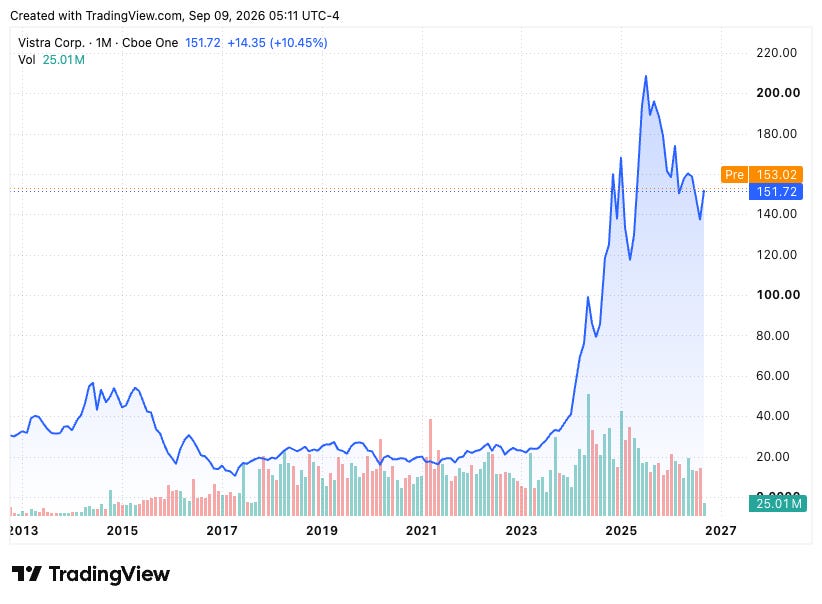
Wall Street still loves the story
The analysts have by no means given up on Vistra.
Of the 17 analysts monitored by PriceTargets, 15 have assigned a Buy or Strong Buy rating, two have given a Hold rating, and no analyst has rated the shares as a Sell. The agreed-upon target price is about $224. Morgan Stanley increased its target to $227 in August but has still maintained its Overweight rating. TD Cowen, UBS and JPMorgan have also kept their positive stance.
Investor conversations are also largely positive, although not nearly as cautious. Vistra is still seen as a means of owning the physical infrastructure underlying AI rather than as another software firm claiming that a chatbot will revolutionize dentistry.
The company offers investors a great deal.
In August, Vistra announced the formation of Helix Digital Infrastructure in association with KKR, the Kuwait Investment Authority, and NVIDIA; it will be able to invest up to $1 billion at the start and will act as Helix's preferred power provider. Furthermore, Vistra's second-quarter adjusted EBITDA from its ongoing operations increased by more than 30%, and management has confirmed the full-year guidance.
The quarter had blemishes. Revenue and reported earnings missed Wall Street estimates, while derivative hedges produced large mark-to-market losses. I like to point this out because some of you care about these things; however, I don’t. At least not in the classical numbers sense.
Then Jim Burke bought $1.17 million
On August 24, Vistra CEO Jim Burke bought 2,000 shares at $135 each, a $270,000 open-market purchase.
One week later, on August 31, Burke bought another 2,200 shares for roughly $299,000. And wait for it, on September 1, he bought another 4,465 shares for roughly $604,000.
In a little more than a week, Burke bought 8,665 Vistra shares for about $1.17 million.
These were reported with transaction code P. They were purchases, not stock awards, option exercises, or compensation shares, made to look like insider conviction.
Since Burke already had a large position in Vistra, these purchases only increased his holdings by less than 1%. Moreover, I don't think that a number of other executives are joining him. This is the case of a single insider making repeated purchases, not the entire senior management team rushing in.
Still, a CEO voluntarily putting more than $1 million into his company within days gets my attention, especially after the stock has fallen sharply.
The crowd could still be right
Vistra is not hated.
Wall Street remains overwhelmingly bullish, and the AI electricity thesis is hardly a secret. Investors have spent years discovering that data centers require power, a breakthrough that apparently needed several trillion dollars of market capitalization to fully sink in.
There are valid grounds for caution. Funding for the broader AI infrastructure boom is now under greater scrutiny. Political opposition to the development of data centers has also increased in Texas as voters become concerned about rising electricity bills and the strain on the power grid. Should spending on AI infrastructure fail to meet expectations, companies that currently enjoy an AI-related cost advantage might lose it as well.
So the appeal here is not that everyone hates Vistra and the CEO knows better.
The more interesting setup is that the stock has fallen sharply even though Wall Street remains positive and the power-demand story remains intact. During that period of weakness, the person running the company bought stock three times with his own money.
That is enough for me.
I’m investing $10 in VST.
The crowd still likes Vistra. The stock no longer acts like it. Meanwhile, the CEO has spent about $1.17 million buying the gap. My green light is blaring green.
Yesterday I bought $10 in RIVN. Full portfolio update coming up on Sunday.