

Rivian (RIVN) has mostly been a faith-based investment. You either believed the story or you looked at the numbers and ran. Lately, the story is getting harder to ignore.
Zacks called Rivian an Underperform in November 2025. By August 2026, they upgraded it to Neutral. Not exactly a ringing endorsement. Their price target? $17, with the stock trading at $16.
But here’s the twist. Over the past year, Rivian shares climbed 32% while the rest of its automotive peer group dropped 22%. The stock started moving before the analysts did.
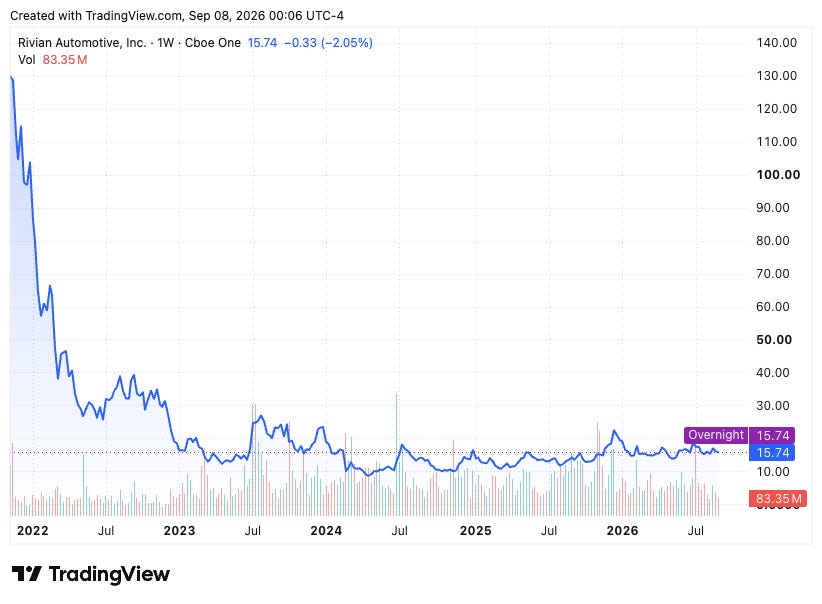
Skeptics are still circling. But it’s getting harder to write Rivian off.
R2 gives people something real to argue about
Rivian finally has a vehicle that isn’t just for people who want to cosplay as tech billionaires on a camping trip.
R2 deliveries started in June. The first model goes for $58,000, but apparently that didn’t scare off reservation holders. Management claims conversions beat their own expectations. Cheaper versions are coming in 2027. After Q2, Rivian even bumped up its 2026 delivery forecast. (Reuters)
The old Rivian story required patience and a healthy imagination. R2 was coming. Scale was coming. Better margins were coming. Everything good lived comfortably in the future.
Now R2 actually exists. And people are buying it.
There’s also a software business now, and it’s not just a footnote. Software and services pulled in a 42% gross margin last quarter, thanks in large part to Volkswagen. That means Rivian has a shot at making money from something other than building cars—a business that’s had a hundred years to get profitable and still manages to lose money in new and creative ways.
Wall Street remains divided. Stifel recently maintained a Buy rating with a $22 target price. Needham sits at $23. JPMorgan and Morgan Stanley remain more skeptical. (TipRanks)
I’ll take disagreement over mindless hype any day. Rivian still has to earn it.
A director bought $251,000 worth
Aidan Gomez, a Rivian director, bought 18,000 shares at $13.97 on May 15, spending about $251,000.
The SEC filing lists the transaction as code P, an open-market purchase. No stock grant. No option exercise. Gomez chose to buy the shares with his own money. (SEC)
The purchase also increased his position by a meaningful amount. Rivian’s April proxy showed Gomez owning 39,984 shares beforehand. (SEC)
The timing is worth an eyebrow raise. He bought in less than a month before R2 deliveries started rolling out.
I want the insider story more if other executives were joining him. They are not. CEO RJ Scaringe has not made any recent open-market purchases, and Rivian disclosed in June that he had adopted a 10b5-1 plan covering potential future stock sales. That does not make the plan bearish on its own, but Gomez is currently the insider-buying story here. (SEC)
The cash burn can still wreck the story
Rivian burned $849 million of free cash flow in the second quarter. The R2 launch added roughly $100 million in costs; the automotive business still posted a gross loss, and Rivian later raised more equity.
If R2 requires repeated capital raises while Rivian struggles to improve manufacturing economics, the bears will have been right to stay suspicious.
For now, though, belief is moving in the right direction. Zacks has gone from Underperform to Neutral. R2 is in customers’ hands. Early demand has beaten management’s expectations. The stock has been outperforming its industry. And one director put about a quarter of a million dollars of his own money into Rivian shortly before the R2 launch.
That is enough for me.
I’m investing $10 in RIVN.