

Keel Infrastructure (KEEL) used to be Bitfarms, a Bitcoin miner. Now it is trying to become something very different.
So the company is winding down its mining business and trying to rebuild itself as an AI data center landlord. In June, Keel finally pulled the plug on its last U.S. Bitcoin mining rigs. The new pitch? AI will need a lot of electricity, and Keel owns sites that could, in theory, begin supplying power to data centers by 2027. That’s the story, anyway.
Investors liked the story for a hot minute. KEEL hit $7.37 in June. By Wednesday, it was down to $3.71. The issue is simple: you can’t collect rent from empty buildings.
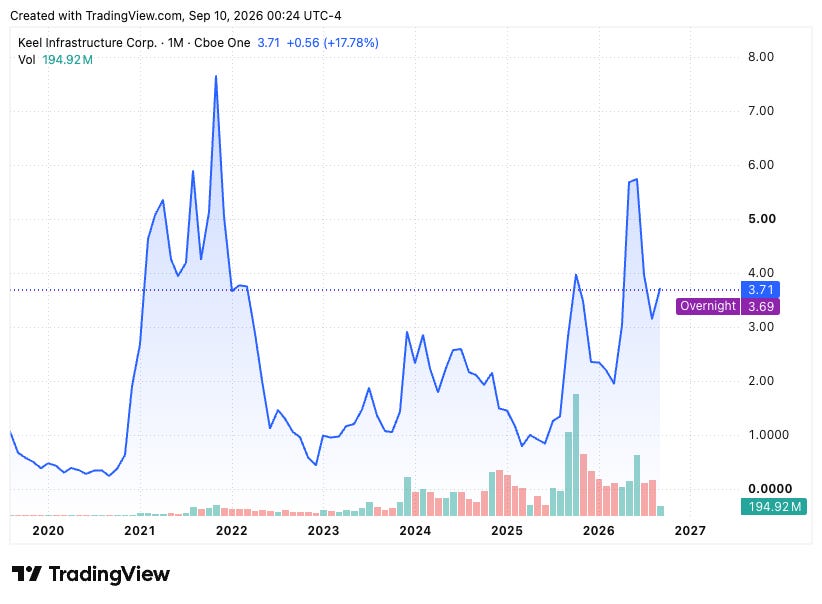
Everyone is waiting for a lease
Keel’s big hopes rest on three sites: Moses Lake in Washington, plus Sharon and Panther Creek in Pennsylvania. All waiting for someone to move in.
Earlier this year, management set a nice, round goal: three leases in 2026, one per site. Simple math. Or so it seemed.
August showed up. The leases did not.
On the Q2 call, an analyst asked CEO Ben Gagnon if the three-lease target was still alive. Gagnon dodged. Negotiations are ongoing, he said. No details. No updates. Just vibes.
B. Riley stuck with its Buy rating after earnings but admitted the leasing timeline is now anyone’s guess. Management doesn’t sound too eager to promise three leases by year-end anymore.
Retail investors have noticed the delay too. Recent Keel discussions range from people convinced that a hyperscaler deal will transform the company to investors wondering how long Keel can keep spending money while talking about customers it has yet to sign with.
Short sellers are getting more interested. Short interest rose from about 13% of the float at the end of April to more than 20% by mid-August.
The market wants proof now.
Wall Street is still bullish
Analysts have been far more patient.
As of August, 10 of the 11 analysts tracked by Stock Analysis rated Keel Buy or Strong Buy. One rated it Hold. None rated it Sell. Recent targets from Northland, H.C. Wainwright, BTIG, and Citizens JMP ranged from $5.50 to $10.
Their argument is mostly the same as the one investors liked earlier this year.
Keel says it is negotiating with multiple prospective tenants across all three priority sites, and some potential customers have shown interest in more than one of the properties. The company also ended the second quarter with $819 million of liquidity, giving it room to keep developing the sites while negotiations continue.
But none of that replaces a signed lease. Then management started buying the stock.
The CEO and COO are buying
Four days after earnings, Gagnon bought 58,888 shares on the open market for roughly $196,000.
A few days later, COO Liam Wilson bought about $100,000 worth.
Wilson bought another $100,000 three days after that.
The following day, Gagnon returned and bought roughly another $129,500.
Between August 13 and August 21, Keel’s CEO and COO spent about $526,000 of their own money buying shares in four open-market transactions.
These were not stock grants, compensation awards, or option exercises. They chose to buy shares with cash.
The timing matters more to me than the dollar amount.
They bought after the second-quarter update. They bought after management stopped reaffirming the tidy three-leases-in-2026 target. They bought the stock, which was trading around $3.25 to $3.78, less than two months after it had touched $7.37.
Investors were losing patience while the two executives running the company were adding to their positions.
They could still be wrong
Keel hasn’t proven it can actually pull off this pivot.
It needs customers to sign leases. Negotiations can drag on. Permits can slip. Data centers require capital before they produce rent. A company can spend a long time in “in discussions” with prospective customers without those discussions turning into anything shareholders can cash in on.
And insider buying does not make management right. What it does give me is a disagreement worth watching.
The stock has been cut in half since June. Shorts are piling in. Investors want to see powered sites turn into actual contracts, not just PowerPoint slides.
At the same time, its CEO and COO spent more than half a million dollars buying shares after the market had already heard the bad news.
A lease would change the story. Until then, I’m betting a small amount that the people closest to those negotiations are buying while everyone else is getting tired of waiting.
I’m investing $10 in KEEL.
Yesterday I bought $10 in VST. Full portfolio update coming up on Sunday.